

How to Prepare for Grocery Inflation
Inflation and groceries. This is something that I’ve been pondering deeply for the past several years, and I am diving into the research today to explain why. If you have too, and if you are wondering what to stock up on before inflation gets worse, keep reading!
I have long been a believer in the importance of having a stockpile. The shortages during the pandemic proved my point. And now, as I look ahead, I am more convinced than ever that building a stockpile can help families prepare.
Whether you have had a stockpile in the past or have never thought about it before, I think now is a good time to consider it.
Think of a stockpile as a practical emergency fund to prepare your family for whatever may come. It doesn’t replace money in savings, but it gives you food and supplies to use when your budget is tight.
If you have a loss of income for a time, or if prices suddenly increase due to inflation, having a stockpile will help you through.
Consider it being a good steward. I consider it my responsibility to care for my family by stretching our pennies.
This is why inflation has caused me to rethink a lot of things and work harder to prepare our home, family and yes, stockpile.
So, let’s dive into all this talk about inflation and how it is affecting our grocery budgets.
Note: I originally wrote this post in June 2021. This update uses September 2026 grocery inflation data and the USDA’s October 2026 Food Price Outlook, reviewed in November 2026.

What Is the Current Grocery Inflation Rate?
According to the Bureau of Labor Statistics’ September 2026 Consumer Price Index, grocery prices were 1.8% higher in September 2026 than in September 2025. Remember, this is for a year over year total. Just one year at a time.
The government calls groceries “food at home.” This is the number to look at when we are talking about the food we buy at the grocery store to prepare at home.
Prices for all food, including restaurants, increased 2.5% over the same 12 months. Restaurant and other foodservice prices increased 3.5%.
Those are national averages. Your grocery bill can look very different depending on where you shop, what you buy and which sales you find.
We’ve all seen the prices jumping up here and there, but it is even more startling to see the proof in print. Taking this into account, I believe it is wise to prepare your family and your budget for changing prices.
How Much Are Grocery Prices Expected to Increase?
The USDA’s October 2026 Food Price Outlook forecasts that average grocery prices will increase 2.3% in 2026 compared with 2025. Its forecast range is 1.9% to 2.7%.
This is a forecast, rather than a final result. It compares average prices across the full calendar year with the previous year’s average. The 1.8% figure above compares one September with the previous September, so these numbers measure different things. We don’t add them together.
We won’t know exactly how much full-year average prices have changed until the year is finished. In the meantime, we can keep watching prices and making the best decisions for our families.
Why Are Groceries Still Expensive If Inflation Is Slowing?
This is a very important question!
While food inflation might be slowing, the increases are still building on top of one another. A lower inflation rate doesn’t mean that prices have returned to what we paid several years ago. It means that, on average, prices are increasing more slowly.
For example, if a basket of groceries goes from $100 to $110, that is a 10% increase. If the same basket then increases another 2%, it costs $112.20. The inflation rate is lower, but you are still paying more for the same groceries.
That is what our wallets are feeling. We are trying to fit today’s prices into budgets that may not have grown nearly as much.
Some individual prices do come down. A good sale can also bring an item below what you paid last month. But slower inflation by itself doesn’t erase the increases that have already happened.
This is why I think it is helpful to watch the prices of the things your family actually buys. The national average gives us context, but knowing a good price on your regular groceries helps you decide when to stock up.
Which Grocery Prices Are Rising the Most?
Let’s break it down a bit more. According to the USDA’s October 2026 report, these were some of the changes in grocery prices from September 2025 to September 2026.
| Grocery category | Price change over the past 12 months |
|---|---|
| Coffee | +7.1% |
| Sugar and sweets | +5.5% |
| Fresh fruit | +4.9% |
| Beef and veal | +3.5% |
| Fresh vegetables | +2.8% |
| Poultry | +1.1% |
| Eggs | −20.6% |
Year over year means we are comparing prices with the same month one year earlier. These are retail price changes, rather than changes in the commodity prices used to produce our food.
Notice that not everything is going up. Egg prices were lower than a year earlier, even while several other categories increased.
If your family buys a lot of beef or coffee, you may notice more of an increase than a family whose regular grocery list looks different. That is another reason I don’t think we can rely on one inflation number to tell the whole story of our grocery budgets.
How to Prepare for Inflation at Home
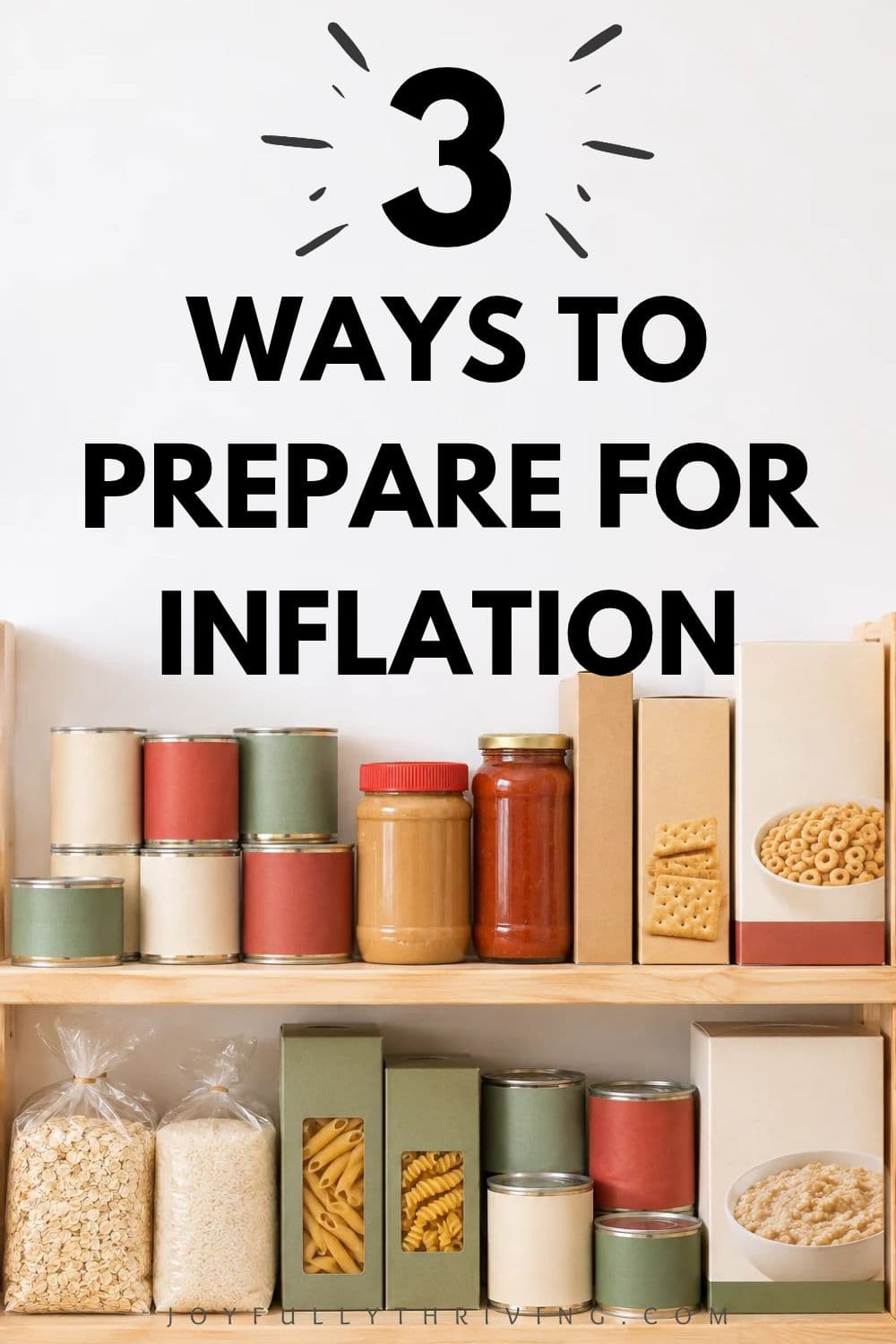
There are a couple simple ways to prepare for inflation with food prices. I think it is wise to prepare now and start buying things before you need them. In simplest terms, that is what a stockpile is.
Here is a hypothetical household example. Say that toilet paper goes up by 15%. That means the package of toilet paper you pay $10 for every month would cost $11.50. That works out to an extra $18 a year, just to buy the same toilet paper you were already buying. Multiply that scenario by multiple items increasing in price and you will quickly feel the impact on your budget.
The same principle applies to food. If you can buy an extra jar of peanut butter or a box of pasta at a good sale price, you have one less item to buy at full price later.
If inflation doesn’t increase as much as you thought it could? Then you will still have useful food and supplies on hand. The savings depend on what you paid and whether you use what you buy. Buying ahead works best when you are stocking up on a good deal, rather than simply buying more at any price.
Follow the simple advice of “Buy 1 for now, and 2 for later” when your budget allows. Try not to let yourself get down to the last item in your pantry before you start watching for a sale.
Always be looking and shopping ahead. When you see a good sale, stock up as much as your budget, storage space and family’s needs allow.
You might consider moving a little money from another area of your budget to buy a few extra things. But start with what you can afford. Even one extra item is a beginning.
Start with What You Already Have
Before you buy anything, check your pantry, refrigerator and freezer. What do you already have? What are you almost out of? What needs to be used soon?
Make a short list of the things your family uses regularly. Those are the items to watch for in the sale ads. You don’t need to build someone else’s stockpile. You need to build one that works for your family.
Know Your Prices
Keep track of the regular price and a good sale price for the items you buy most often. Compare the price per ounce, pound or count, especially when package sizes change.
A sale sign doesn’t automatically mean something is a good deal. And a bigger package isn’t always cheaper! Knowing your prices helps you decide when to buy one and when to buy extras.

What to Buy Before Grocery Prices Rise
Wondering what to stock up on before inflation increases your costs further? Focus on the food, household supplies and toiletries your family already uses.
You don’t need to predict exactly which item will increase next. Start with useful items at prices that make sense for your budget.
Build a Stockpile of Household Goods
This is one way to prepare for inflation. Along with food, consider household goods that store well and that your family uses regularly.
Here are some ideas of household supplies to stockpile.
- Toilet paper
- Paper towels
- Laundry detergent
- Dish soap
- Disinfecting wipes
- Diapers
- Baby wipes
These purchases come out of many families’ grocery budgets too. Having an extra package of toilet paper or bottle of detergent can leave more room for food in a future shopping trip.
Build a Stockpile of Things You Use Regularly
Similar to the above, expand your stockpile to focus on the toiletries and other things your family uses regularly. Don’t buy things you don’t use, because that is simply money wasted.
- Shampoo and conditioner
- Hand soap
- Bar soap
- Deodorant
- Toothpaste
- Over-the-counter medicine
- Vitamins
Check expiration dates where applicable, follow storage directions and buy quantities you can realistically use. If you are buying diapers ahead, remember that children can outgrow a size before you finish a large supply!
What Foods Should You Stock Up On?
Build a stockpile of foods your family eats. This includes pantry staples as well as foods you can safely store in your freezer.
Whenever you see a good sale, purchase extra of the food items you use. If you have space in an extra freezer, focus particularly on buying meat when you can get a good price.
As for canned goods and other packaged items, buy quantities you can use and rotate your supply so the oldest items are used first.
If you are wondering what food to buy before prices increase further, some of the best food items to stockpile include:
- Peanut butter
- Pasta
- Canned tomatoes
- Canned meats
- Baking goods — flour, sugar, yeast, etc.
- Cooking oils
- Canned vegetables and fruits
- Applesauce
Depending on what your family eats, you might also add rice, oatmeal, beans, broth or pasta sauce. Think about meals you can make with these ingredients, rather than filling your shelves with foods that don’t work together.
As with all of these things, focus on doing what you can with what you have.
Can you spend a little less this week to buy an extra pack of toilet paper? Or can you find some extra money to buy a couple extra packages of diapers? Can you buy 4 containers of the dish soap that is on sale instead of just 1?
Remember that useful items bought at a good price can help you prepare for the future. You don’t have to buy everything at once.
If you want to learn more about stockpiling, I have a printable ebook called “The Quick Start Guide to Building a Stockpile on a Budget.” It is full of helpful tips, handy checklists and more to help you build a stockpile — even with higher grocery prices!

Should You Stock Up Before Inflation Gets Worse?
I think it is wise to have extra food and supplies on hand, but that doesn’t mean you have to rush out and fill your cart today.
If you arrived here wondering what to buy before hyperinflation hits, the practical starting point is the same: buy useful food and supplies gradually, watch for good prices and stay within your budget. The grocery inflation figures above are not a prediction of hyperinflation.
A stockpile can help with rising prices, a tight month or an unexpected expense. You don’t need to know what the economy will do next to benefit from planning ahead.
What Else Can You Do to Prepare for Inflation?
There are some simple things everyone can work toward, regardless of their family size or income level.
Pay off all your debt.
Paying off debt is always a smart move. I know someone would say that if hyperinflation hits, debt won’t really matter. I still believe it is important to pay off your debt.
Have money in savings.
Yes, when inflation hits, your money won’t go as far as it used to. That means things like home repairs – or a new vehicle – will cost more. You need to save now for these expenses. We have over 20 savings accounts for this very reason.
Buy what you can now.
If you can free up some money in your budget, consider buying a planned purchase when you find a good price. This is true for a stockpile as well as bigger purchases. Focus on things you already need and can afford, rather than buying something simply because you are worried prices might rise.
Plan for the future.
We should always be doing this, but I know there are many who live from paycheck to paycheck. Work hard. Build a stockpile. Save money. Be prepared for what may come – and if inflation returns to normal levels, you will still be prepared for the future. You won’t have lost any money but saved yourself worry from the possibility.
Some people might say I’m taking things too seriously and others might say I’m not taking it seriously enough. Whatever side you fall on, I hope you will consider how you can best care and provide for your family. And if these tips help you to build a stockpile that will save your family money, then I have done what I hoped to do.
What are your thoughts on food prices and inflation? Have you started doing anything differently lately as a response or preparation?
If you want to read more about stockpiling…
- How to Build a Stockpile Today
- 5 Baby Steps of Stockpiling
- How to Stockpile Diapers
- 25 Best Things to Stockpile at Sam’s Club



Going to try and keep this short (shorter than I would usually write) as I am now 68 and have been practicing frugal living habits for my whole life. We have not had to deprive ourselves of anything we want/need, raising three children and ongoing “adoption” and support of rescue dogs. Through frugality, we also own 2 houses (“rent” one to our youngest son and his family at 70% below market values), own our vehicles, bills all paid and overfilled larder (I like those words :overfilled and larder!). We have even taken multiple worldwide and Caribbean vacations. It does, though, take a concerted effort to do this and keep your minds on track. I am disabled, now, and in a wheelchair full time so I’ve had to slow down some. Used to be the queen of coupons/sales, grew all our own produce, canned everything and stockpiled other items. Husband and I have been together for over 40 years and frugality has been my mantra…but not that of my husband (!), but he tolerates it. Due to increasing inflation and now being on a fixed income, due to retirement, he does not complain as much! Our children, who have obviously not practiced or used these principles, are often broke and can only commit to necessities and when they visit, they all laugh at me and make jokes, which are a little hurtful, at times! Our oldest DIL had asked me to “teach” her how to use coupons and sales combined. They now use less meat per meal and buy it from a local wholesaler. She also raises poultry, for the eggs. She is now on my A-ok list! Since I have a very, very healthy overstocked pile, I follow 2 basic principles: 1- rotate, rotate all your stock to use oldest first and 2- replace what you use (when sales/funds allow), to prevent zero back up food items for emergencies.
Stockpiles are needed and can be completed through careful planning and resource utilization. I have been using and enjoying, money saving tips for almost everything I do and often when I read one online, I think “oh, I have been doing that for years, it’s nothing new!” I enjoy challenges and some tips I’ve developed myself. Your article gives everyone a rationale and planned start! Loved it! No reason not to start!
Mertie,
You sounds like a brilliant woman! I will definitely take your wisdom and add to my collection of frugal living tips. Thank you for sharing your insight!
I am being more careful about checking sales ads of the different grocery stores in my area and compare their prices so I get what I need at the lowest prices.
I’ve also learned that there are many things in my yard that I can use to supplement my budget. We are now using the leaves of my green pepper plants in salads and casseroles, as well as the leaves of our zucchini plants. A Google search will turn up a dozen or more easy ways to supplement what’s on your table, while working that stockpiling budget. God has been astonishing me with His faithfulness!
Surprised no one has brought up water bath and pressure canning. I find meat deals, bring them home and can them. Shelf stable and convenient. Got attachment to our kitchen aid mixer, stainless steel meat grinder and grind our hamburger…. Put in 2 lb food saver bags to extend the life in the freezer. Just about any kind of meat can be pressure canned. 75 minutes for pint jars and 90 minutes for quart jars. Frozen veggies can be pressure caned to free up space in the freezer.
I started to feel so anxious on all of this tonight… was already. Have been preparing for this for some months but am realizing there is SO much more to prepare for and the need to take care of it all is NOW! Thank you so much for sharing this page, it was helpful to hear from someone else who wants to be wise and plan ahead but whom also trusts in her God.
We will surely all need Him in this season and in what lies ahead!
Oh, Pam! Yes, indeed! There is always more we can do, so I continue to balance our budget with the urgency of stockpiling for my family as well as leaning on my faith, and trusting that God provides. It is wonderful to hear from other Christian women who are doing the same – especially in the weeks and months ahead!
Bless You! I’m truly grateful that you chose to share your knowledge with those of us who feel a little less prepared. I prayed before starting a list of things that I should be buying now and I asked God to help me to know how to go about this wisely. I then proceeded to search Google and your article was front and center and I want to thank you for listening to the whisperings of the Spirit that told you to share this information. This was written before the war in Ukraine and I feel so grateful as this information is all the more important now!
Thanks for being an answer to my prayer this day!
Oh, Shannon! Your comment truly warmed my heart. I love seeing how God works, and I am so thankful that I could be your answer to your prayer! I know how overwhelming this all can be, especially as we watch events unfold in Ukraine. But God has given us the gift of discernment, and I truly believe that preparing by buying some things now will help anyone – regardless of what happens with the future. We don’t know what the future holds, but we know who holds the future! I am praying for you as you begin preparing for your family! Oh, and if you are looking for more stockpiling help, I did just finish a 30 page ebook called The Quick Start Guide to Building a Stockpile that might be helpful to you as you make your lists. Many blessings!
Thank you for sharing your wisdom. I’m new to stockpiling at all and am thinking that it’s better to get ahead of what seems to be coming. It doesn’t hurt to be as prepared as possible!
That is exactly my thought as well, Clarissa! It never hurts to do what we can to be prepared – especially when it comes to things we will definitely use – like food!
I have decided that I am serving too much meat So I can get by with less if I make more casseroles with more vegetables. I also do not make many desserts. Fresh fruit is usually our dessert of choice.
That is a great point, Carol! I’m working on expanding my casserole selection too!
Dollar General has smaller sizes on certain items to keep the product at a certain price point. I don’t mind because I’m aware and watch for it. Similar to decreasing sizes instead of raising prices. I like the smaller sizes of snack foods like chips so I don’t eat too many!
I also love to shop DG on Saturdays when you can save 20% off a $25 purchase. For staples and canned goods, this is a rare discount. You can get the discount onntheir website and in their app. I rarely buy more than about $25 to maximize my % savings. I’ll just go back next week. Over the course of a month I have $100 of food for $80. I still shop their sale prices and use coupons to max it out too.
I appreciate your balanced advice. Normally, I’m one of those who lets things run out before purchasing more. However with the way things are I’ve been getting an extra bottle of detergent or package of toilet paper. It makes me feel better knowing that we won’t run out too fast. Thank you for sharing specific things to stock up on!
Great info! Thank you!
I try very hard to keep a well stocked pantry for times when money is tighter than normal. We eat a lot of weird combo’s sometimes to use up food. This month we are doing bare minimum shopping to use up some of the things we have had for a while. So it means weird combos to eat. When shopping I look for the discounted items that we will eat and try to plan meals using them. Right now it is frustrating to grocery shop because so many things are in smaller sizes for larger prices. Or the store has bare shelves. Meaning you have to go to more stores to find the things you need. It is hard with diet restriction for myself (heart failure = no sodium) and hubby (diabetes). Fresh produce is ridiculously priced. Things that are in season are sky high. We planted our own tomatoes and strawberries and blueberries this year. Hope to expand that next year. Inflation irritates me in general. Once the price goes up (for whatever cockamamie reason they use to raise it) it NEVER returns to a normal price. Think about the price of milk…$3-4 a gallon. Chicken prices right now are stupidly high. It is hard to reign in the grocery budget when the food prices sky rocket!!
You are very wise, Rebecca, to plan ahead. And weird combos are okay – when you have food on your shelves! One of my projects this week is to reorganize our pantry so I’m using things too. And yes, I have those same frustrations! The shrinking sizes is especially obvious right now! It is definitely a challenge, but good for you in planting a garden and making plans to expand it. My kids and I would absolutely LOVE to have blueberries, but our soil just doesn’t seem to work for them. But yes, the rising prices don’t seem to come back down…so we have to plan and continually adjust and be smart shoppers.
We actually planted our blueberries and tomatoes in horse troughs (strawberries are just in large flower pots on the front porch) and purchased some dirt from a soil company to make sure that we had nutrient rich soil to grow the berries and tomatoes in. I am not looking to have any blueberries for quite a while but I have an abundance of tomatoes and strawberries coming in right now!
The dish soap I used to buy recently changed from 25oz to 19oz for the same price. Same happened with the BBQ sauce is in a much smaller bottle for same price. Canned mushrooms pieces and stems used to be about 59cents were 89cents today. I have started adding to my stockpile what we use and also have coupons for or on sale now, even if not out of it yet. So today paper towels and the body wash the boys like was added to the cart. In addition to inflation, it is weird what there is a low supply of sometimes when I shop. So I’m trying hard to not get down to just one of anything-sometimes it has taken several weeks to find pepperoni etc.
Yes! The smaller sizes are happening more and more regularly, with big jumps happening on the things that aren’t changing sizes. I think you are wise, Rachel, to add to your stockpile when you can. Oh, and yes! I’ve noticed the same with random shortages and low supplies. I’ve started filling in some of my gaps on Amazon, and have been pleasantly surprised at the deals I have found – especially on toilet paper and wipes. Watching the deals is a great way to save our families money!
What I would add at 71 , buy extra onsale. Watch prices like coffee. 5.99 in 2024/25 a good price. So Kroger puts it onsale as a come on sale. I buy their max 5 every time. My daughter gives me her coupon so I buy 5 more. My mother always said buy a years worth if possible. Rotate food as you use it. April 2025 coffee onsale 8.99 but I have a years worth on shelves so I pass . Toilet paper I buy this way too